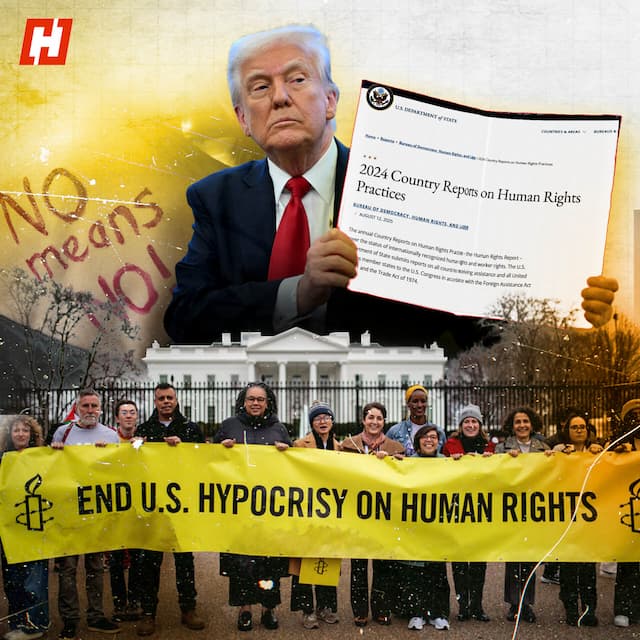
The US government’s annual report on global human rights abuses, officially called the 2024 Country Reports on Human Rights Practices, is being slammed by critics and human rights organisations, both home and abroad.
The once comprehensive bipartisan document has been significantly rewritten and pared down by the Trump administration - eviscerating it of its original intent, upending decades worth of work and calling into question the US’ moral high ground on human rights.
The criticism stems from the softened criticism of pro-Trump partners such as Israel, El Salvador and Saudi Arabia while conversely rebuking traditionally close US allies such as the UK, France and Germany along with perceived foes such as Brazil and South Africa.
Moreover, entire sections included in reports from previous years have been eliminated. The omissions include reporting on violence toward women, persecution of LGBTQ+ individuals, corruption in government, systemic racial or ethnic violence, or denial of a fair public trial.
Department Spokesperson Tammy Bruce though wants everyone to believe the changes have made the report better. Bruce declared the Human Rights Reports (HRRs) have been restructured in a way that removes redundancy and increases report readability.
Since the US Congress first mandated the HRRs in 1977, they have demonstrated the US’ enduring commitment to protect human rights. More importantly, these reports are critical in shaping US foreign policy - especially when it comes to foreign aid and weapons sales.
The first reports, released in 1978, only covered the 105 countries that received aid from the US in 1977. But today, the Department of State also submits reports on all United Nations member states, totaling 194 in 2023.
Beyond bureaucrats, these reports have also served as a blueprint of reference for global rights advocacy.
The highly-anticipated document was finally published on Tuesday following months of delay. This after sweeping changes were made to the State Department’s Bureau of Democracy, Human Rights and Labor - the body that prepares these reports.
Many of the staff who worked on the reports were fired earlier this year after the bureau’s focus shifted to “advancing the Administration’s affirmative vision of American and Western values.” The delay also comes amid reports of significant internal dissent at the State Department over its contents.
Under US Constitutional law, these annual human rights reports (HRR) are to be issued by February 25 each year but in practice, the issuance has often been delayed until March or April.
A CNN report suggests the latest HRR was largely completed before Trump began his second term as US President. However, it underwent significant revisions in the subsequent months.
Bruce put the delay down to the fact it was a transitional year. She told reporters that the Trump administration wasn’t going to put out a report compiled and written by the previous administration. She added the report needed to change to better reflect Trump’s point of view and vision.
However, the watered-down report is said to be following internal guidance issued earlier this year. An NPR report details an internal State Department memo instructing employees editing the reports to remove whole categories of violations not “explicitly required by statute”, including gender-based violence, corruption and environmental justice.
Employees were told to remove roughly two-thirds of the content in what officials there call an effort to conform to some executive orders on related issues issued by President Trump. Moreover, the report also breaks precedent after Secretary of State Marco Rubio did not provide a written introduction to the report nor did he make remarks about it.
Several experts opine that the report sends a signal that there’s going to be a free pass from the US government, that it will look the other way if a government is willing to cut deals or do the bidding of the Trump administration - much like the Central American nation of El Salvador.
El Salvador has been accused by Amnesty International of “arbitrary detentions and human rights violations” including “inhumane” detention conditions. However, the State Department report concluded there were “no credible reports of significant human rights abuses”.
For the uninitiated, US President Donald Trump has a close relationship with El Salvador’s President Nayib Bukele. He has repeatedly praised Bukele - like in April when he lauded him as “one hell of a President” and doing a “great job”.
When talking about Israel too, the report includes a far less extensive documentation of instances of human rights abuses. So much so that it leaves out any reference to “significant human rights issues”, which is in the 2023 report. Notably, there is no reference to allegations of torture of Palestinian detainees by Israeli government officials - again, something that were included in the previous year’s report. The report only states that the Israel Security Agency and police “used violent interrogation methods.”
Alarmingly, there is also no mention of the criminal trial of Prime Minister Benjamin Netanyahu on charges of bribery, fraud and breach of trust, which were ongoing at the time.
Furthermore, the International Criminal Court’s (ICC) arrest warrants for Netanyahu, former Defence Minister Yoav Gallant and a Hamas commander, Mohammed Deif too find no mention. This despite the ICC judges concluding there were “reasonable grounds” that the men bore “criminal responsibility” for alleged war crimes. Both Israel and Hamas have consistently rejected those allegations.
However the report sings a very different tune when it comes to nations such as Brazil, a nation Trump has very publicly clashed with, especially its President, Luiz Inácio Lula da Silva, on several occasions.
The latest HRR details found the human rights situation declined, after the 2023 report found no significant changes. In particular, it took aim at the courts, stating they took action undermining freedom of speech and disproportionately suppressed the speech of supporters of former President Jair Bolsonaro, among others.
Similarly, the report lambasts traditionally allied countries like the UK, Germany and France, alleging a deteriorating human rights situation in 2024. It noted that the “significant human rights issues included credible reports of serious restrictions on freedom of expression”.
Trump 2.0 officials have condemned the European nations due to regulations on online hate speech. The language used echoed previous criticism by the Trump administration and some US tech bosses who oppose online harm reduction laws in some European countries, portraying them as attacks on free speech.
Senator Chris Van Hollen, a Maryland Democrat slammed the revisions labelling them “an irresponsible use of tax dollars” that deny both policy makers and the public “the unvarnished truth” about human rights situations abroad. Because he believes the Trump administration won’t report on what’s happening in other countries since it is consistently undermining human rights back home.