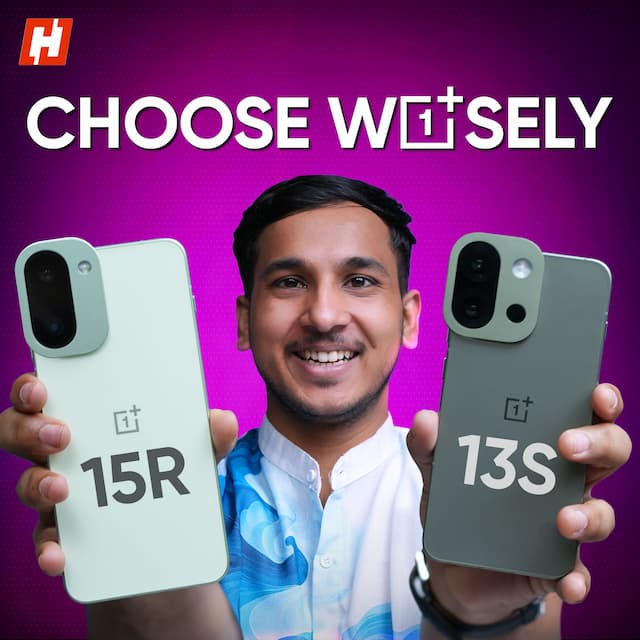
I’ve been bouncing between the OnePlus 13s and the brand-new OnePlus 15R, and I’ll be honest, this one isn’t as obvious as it looks.
You would think the choice is simple. Small phone or big phone.
But the moment you dig past the surface, the R series starts pulling its weight. The 15R is actually bringing in great value, starting at ₹44,999. And yet, it somehow manages to sneak in a higher refresh rate display, better durability ratings, faster UFS storage, and performance that goes punch-for-punch with the 13s’ chipset.
That said, specs never tell the full story. The real gap shows up once you start using them properly. How long they last, how hard you can push them, how they handle gaming, and where they cut corners. And depending on what you care about, the answer can flip pretty quickly.
Starting with design, at first, these two phones look very different. But once I actually started using them, that gap shrank fast.
The 13s is the compact option. It is easier to grip, easier to use one-handed, and just lighter on my wrist. The camera modules differ, square on the 13s and rectangular on the 15R, but the overall design language is basically the same. Flat glass on both sides, aluminium frames, and a premium feel.
Both phones use the Silk Glass finish, but the 15R handles fingerprints better, especially in the Mint Breeze colourway. The darker 13s smudges quicker.
Durability is where the 15R really takes the lead. It jumps from the 13s’ IP65 to full IP66, IP68, IP69, even IP69K. On top of that, it gets Gorilla Glass 7i, which is clearly better than Crystal Shield in terms of protection. In the hand, they feel similar, but the 15R is the tougher device.
The displays are where I really started noticing some proper differences between these two.
The OnePlus 13s comes with a 6.3-inch screen, while the 15R goes much bigger with a 6.8-inch panel. Both are 1.5K AMOLED displays, and despite the size difference, they look almost equally sharp.
Where the 15R pulls ahead is refresh rate. It gets a 165Hz panel compared to the 120Hz panel on the 13s. That said, the 165Hz only kicks in for supported games. In normal, everyday use, both phones sit at 120Hz, so the difference is not always obvious.
The 13s does fight back a bit because it uses an LTPO panel, while the 15R sticks to LTPS. Brightness is another small win for the 15R. It hits 1,800 nits versus 1,600 nits on the 13s, and that advantage shows up with HDR.
Both phones use in-display fingerprint scanners, but the ultrasonic sensor on the 15R felt quicker and more reliable to me than the optical one on the 13s.
Performance is where things actually get fun for me because, on paper, both of these phones are straight-up monsters.
The OnePlus 13s runs on the Snapdragon 8 Elite. It is fast, efficient, and ridiculously consistent. The 15R is the first phone to launch with Qualcomm’s brand-new Snapdragon 8 Gen 5, and that alone makes this comparison interesting.
The 15R also pulls ahead in RAM and storage. It uses LPDDR5X Ultra RAM and faster UFS 4.1, while the 13s sticks to LPDDR5X and UFS 4.0.
In real-world use, performance is basically identical. Everything feels smooth and fast. Benchmarks are also extremely close. In AnTuTu, the 13s scored 2.93 million, while the 15R came in at 2.92 million.
Where the 15R starts to pull ahead is sustained performance. It shows better multi-core scores in Geekbench and stronger stability in 3DMark. The 13s throttles sooner, which makes sense given its smaller body.
Gaming is the real separator. The 13s delivers around 118 to 120 FPS in games like BGMI and Call of Duty Mobile, but the 15R can push up to 165 FPS and hold it better thanks to improved cooling.
Software is the same on both phones. They run OxygenOS 16, with clean animations, good customisation, and new AI tools like Plus Mind.
Both phones get four major Android updates and six years of security patches. The difference is that the 15R will last one version longer, since the 13s has already used up one update.
Moving on to cameras, this is where the two phones take very different approaches.
The OnePlus 13s gets a 50MP main sensor and a 50MP 2x telephoto, with no ultrawide. The 15R gets a 50MP main camera and an 8MP ultrawide.
In daylight, both main cameras do a solid job. Colours look good and detail is strong, although the 15R underexposes a few shots at times. The 8MP ultrawide on the 15R is honestly underwhelming. Colours can be decent, but detail drops pretty quickly.
At 2x zoom, the difference is obvious. The 15R crops into the main sensor and you start losing detail. The 13s switches to its telephoto, and while colours do not always perfectly match the main camera, the results are cleaner and more consistent.
In low light, the 15R actually surprised me on the main camera and did better than the 13s. But once you switch to ultrawide or zoom in, things fall apart fast. Portraits are mixed. The 15R gives you more framing options, but the 13s produces more natural-looking bokeh.
Both phones use 32MP selfie cameras and perform well. I personally liked the 15R a bit better. For video, the 15R offers 4K at 120 FPS, while the 13s supports Dolby Vision. In a simple 4K60 test, the 13s delivered better colours and stability.
Neither of them is a camera-first phone, but I would still pick the 13s here. A good telephoto beats a weak ultrawide any day.
Battery life is wild on both.
The 13s, with its 5,850mAh battery, comfortably gave me two full days without changing my usage. The 15R takes that and goes bigger. Its 7,400mAh battery, paired with a more efficient chip, just refuses to die. I still got two days with heavy use, and three days is definitely possible.
Both charge at 80W. The 13s takes around 50 minutes for a full charge, while the 15R takes a little over an hour. There is no wireless charging on either, which is a big miss if you ask me.
So which one would I pick?
As much as I like compact phones, the OnePlus 15R makes the stronger case. For day-to-day use, there is no real difference between the 13s and the 15R, but the 15R pulls ahead in gaming, battery life, and overall endurance.
The 13s still makes sense if you want a smaller phone and care more about portraits and that telephoto lens. But if you want the better all-rounder, especially for gaming and battery life, the 15R is the one to get.