| Category | Key Specification |
| Processor | Snapdragon 8 Elite Gen 5 Chipset |
| Display | 6.79-inch 2K AMOLED, 144Hz Panel, 2000 nits (HBM) |
| RAM + Storage | 16GB + 512GB |
| Software | Realme UI 7 + Android 16 |
| Rear Cameras | 50MP Main + 50MP UW + 200MP Tele |
| Front Camera | 32MP |
| Battery + Charging | 7000mAh + 120W |
| IP Rating | IP 68 + IP 69 |
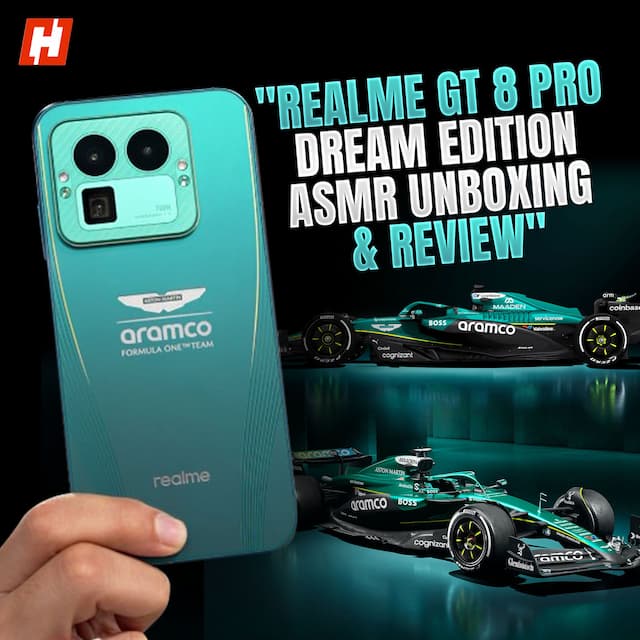
Realme pulled off a shocker back in May with the Aston Martin Aramco F1-branded GT 7 Dream Edition. And now, barely half a year later, the follow-up has arrived. The new Realme GT 8 Pro Dream Edition rolls in with that same motorsport-inspired racing green finish and a premium ₹79,999 price tag. For context, the standard GT 8 Pro begins at ₹72,999. So yes, the “Dream Edition” tax definitely exists.
But the moment you open the box, you understand why Realme thinks it can justify the markup. The Dream Edition immediately gives off ultra-premium vibes, and after spending time with it, there’s plenty that genuinely impresses. Still, a few decisions feel a little questionable and could have benefited from an extra rethink at Realme HQ.
Realme has gone all in on theatrics this year, and you feel it from the moment you open the GT 8 Pro Dream Edition box. The lid lifts to reveal those dramatic wing-style flaps that are clearly inspired by Aston Martin’s Silver Wing emblem. Sitting right at the centre is the phone itself, coated in that deep Racing Green finish. The carved flow lines across the back are not just for show. They give the phone a sporty grip that immediately fits the theme. Even the SIM ejector tool plays along with a racecar design, which is a fun detail you do not expect to matter until you see it.
The one part that does not land as cleanly is the Aramco logo on the back. It takes up more visual space than it should. People interested in this edition are drawn to the Aston Martin connection, not the sponsor attached to the team. Yet the Aston Martin badge feels secondary in the final layout, almost like it is sharing the spotlight rather than owning it.
Then we get to the replaceable camera plate. Realme supplies a tiny Torx screwdriver that lets you swap the circular camera housing for a square one. It is an entertaining gimmick the first time you do it, but once the novelty fades, most users are unlikely to repeat the process. You also receive two cases that match the two plate shapes, although it is hard to imagine anyone actively switching between them.
Once all the branding and accessory experiments are out of the way, the phone itself makes a strong impression. The GT 8 Pro Dream Edition feels solid in the hand with a metal frame, a manageable 214-gram weight, and proper durability thanks to IP68 and IP69 ratings.
The display deserves really deserves all your attention because it is one of the strongest parts of the GT 8 Pro Dream Edition. You get a 6.79-inch 2K AMOLED panel, and it does not disappoint in day-to-day use. Text and visuals look extremely crisp, animations feel quick, and every swipe lands with zero hesitation. An LTPO panel would have pushed the premium factor further, but even with LTPS, the colour reproduction, brightness levels, and overall consistency feel like something you would expect from a flagship.
On paper, the screen supports 144Hz, although that mode activates only inside select games. The user interface stays capped at 120Hz. Slim bezels help the screen blend into the frame, and the flat design means you avoid reflections and accidental touches, whether you are gaming or scrolling outside.
Brightness is another big highlight. Realme claims a massive 7,000-nit peak and around 2,000 nits outdoors. Combined with Dolby Vision, HDR10, and HDR10+ support, HDR content looks vibrant and visually dense without pushing into cartoonish saturation.
Audio does not share the same wow factor. The stereo speakers can go loud, but the tuning lacks detail in the upper range and does not offer any real low-end punch.
On a positive note, the haptics feel precise and satisfying, and the ultrasonic fingerprint sensor has been flawless in every attempt during testing.
The Dream Edition may look special on the outside, but underneath the F1 branding and the customised motorsport-themed Android skin, the hardware is identical to the regular GT 8 Pro. That actually works in its favour, because the specs were already stacked.
At the centre of everything is the Snapdragon 8 Elite Gen 5, and it performs exactly like a top-tier processor should. Long gaming sessions, switching between heavy apps, and continuous background processes do not slow it down. Benchmark runs did push the temperature to around 45 degrees, which is expected during synthetic stress tests. In real-world gameplay, the temperature stayed below 40 degrees even after an hour of BGMI. On Antutu, the phone scored roughly 3.8 million. It falls a little short of the OnePlus 15’s 4 million result, but it still sits comfortably among the highest-performing Android phones right now.
The rest of the configuration keeps the flagship profile intact. The phone ships with 16GB of LPDDR5X RAM and 512GB of UFS 4.1 storage, so there is plenty of headroom for gaming, apps, and file-heavy workflows. The only detail that feels out of place is the USB 2.0 port, which is hard to justify at this price.
Game optimisation is strong across popular titles. BGMI and Call of Duty: Mobile both ran smoothly throughout testing. The display supports 144Hz and Realme says the Hyper Vision+ AI chip increases perceived smoothness by inserting additional frames when games do not render them themselves. COD: Mobile did activate the 144Hz mode, although the game itself caps out at 60fps unless you drop the graphics quality. It reached 120fps during testing, but only on Low graphics with Ultra frame rate enabled.
Realme’s camera story takes a new direction this year. The GT 8 Pro is the first phone built under the brand’s partnership with Ricoh, and for an opening act, it is surprisingly confident. Ricoh’s GR lineup is a cult favourite among street photographers, so Realme is clearly trying to borrow that visual identity and attitude. You can see it the moment you enter the new GR-style shooting mode that offers 28 mm and 40 mm focal lengths, a 3:2 aspect ratio, Ricoh-inspired film looks, and a Snap Focus mode that fires a fixed-focus photo the second you lift the phone. Unlike most first-gen collaborations that feel like a filter pack pasted on top of stock processing, this one carries intention. The film profiles add mood without turning images into caricatures.
The hardware does not rely entirely on the Ricoh branding either. The rear system consists of a 50 megapixel main camera, a 50 megapixel ultra-wide, and a 200 megapixel telephoto with 3x optical zoom. It is also the first time Realme has used a 200 megapixel telephoto on a phone. A 32 megapixel selfie camera sits on the front.
The 50 megapixel main sensor captures detailed images with a bold colour palette and strong contrast. There is a hint of saturation in some scenes, but nothing that feels over-processed. Low light photography is handled well, although Night mode sometimes brightens more than needed. Since the phone uses the same Sony IMX906 sensor as the OnePlus 15, the overall visual character feels familiar and predictable in a good way.
The 200 megapixel telephoto is the standout. The 3x shots have a clean look and make portraits particularly enjoyable. At 6x, there is a slight drop in fine detail, and anything beyond that becomes more of a novelty. Yes, the zoom extends all the way to 120x, but usable quality peaks long before that.
The ultra-wide camera lands at the bottom of the ranking. It is perfectly acceptable during the day, although textures soften quickly and edge detail disappears in low light along with dynamic range.
Video shooting is where the phone quietly flexes. The main and telephoto cameras can record 4K at 120 fps and you can switch to 8K at 30 fps if needed. There is support for 10-bit LOG and Dolby Vision HDR, and the footage holds up against other flagship devices. Colours look rich, highlights and shadows stay controlled, and the pro formats remain available even when shooting in 4K at 120 fps.
The selfie camera is serviceable without standing out. Good lighting brings crisp and punchy photos, while dim situations expose softness and a loss of detail. Autofocus is missing, and its absence becomes noticeable when shooting at close distances.
The GT 8 Pro Dream Edition debuts Realme UI 7, layered on top of Android 16 straight out of the box. It is the first Realme phone to launch with the new software, so users are getting the latest UI experience from day one. Because this is the Dream Edition, Realme also bundles a full Aston Martin–themed skin that leans heavily into the F1 aesthetic. It looks dramatic and stays on brand, but in day-to-day usage, the standard icon pack simply feels more comfortable and visually calmer.
Long-term support is handled well. Realme promises four years of major Android upgrades and five years of security patches, which puts this device in a competitive position for users who plan to hold on to their phones for several upgrade cycles.
The biggest visible shift arrives with the new Light Glass visual style. The lockscreen shows translucent widgets, soft depth effects, and revamped system icons that give the UI a cleaner look. It is clearly inspired by some of the design language from iOS 26, but rather than being a direct imitation, Realme has interpreted it with its own layout and interaction style. Expanded icons act almost like small widgets, letting you jump straight into shortcuts without opening the full app. Video lockscreen wallpapers add personality, and the updated Flux theme engine does a better job of maintaining a single colour palette across menus and system panels.
Bloatware has been kept in check. There are a few pre-installed third-party apps, although they are minimal and can be removed within seconds. Daily usability does not feel compromised by unwanted software.
AI features are tightly integrated. Google’s Gemini Assistant, Gemini Live, Circle to Search, and instant on-screen translation are all available out of the box. Realme adds its own AI-powered gallery tools such as AI Eraser, Ultra Clarity, Unblur, and Perfect Shot. These quick-edit features are simple but useful, especially for casual photography.
Mind Space makes its way to the GT 8 Pro as well. Users can take screenshots, save pages, drop notes, and store loose thoughts in one place. The app then uses AI to organise everything into structured summaries. Anyone who researches frequently or gathers ideas throughout the day will likely find it genuinely practical.
The 7,000 mAh battery inside the Realme GT 8 Pro sounds excessive on paper, but in practice it delivers the kind of endurance that makes you forget where your charger is. On my heavier test days, which included constant social media, camera use, and streaming, I consistently reached around seven hours of screen time. On easier days, where usage leaned more toward texting, navigation, and occasional browsing, the phone comfortably stretched into a day and a half before asking to be plugged in.
The battery does show its limits during gaming. A 45 minute session of Call of Duty: Mobile drained about 13 percent. That is notably higher than the OnePlus 15 under similar conditions, even though the OnePlus model was pushing 165 frames per second. When the workload spikes, the power draw becomes more noticeable.
Charging performance holds up well. With 120 W wired charging and Smart Rapid Charging enabled, a full charge takes around 47 minutes. Turning the feature off pushes the time closer to an hour, but the phone stays much cooler during the process. There is also 50 W wireless charging for quick and convenient top-ups when you are not in a hurry.
Here is the straight answer. The Realme GT 8 Pro Dream Edition is not trying to be subtle. It wants attention and arrives with the confidence of a phone that believes it belongs in the premium space. In many areas, it earns that attitude. The Snapdragon 8 Elite Gen 5 performs like a flagship should, the 2K AMOLED display looks fantastic, the battery endurance is impressive, and the Ricoh camera experience adds a creative twist that is genuinely fun to use.
There are a few choices that make you stop and think. A USB 2.0 port on a phone at this price feels outdated, the LTPS panel would have been more compelling as LTPO, and the interchangeable camera plates feel like a novelty rather than a feature people will keep using.
After spending proper time with it, the phone delivers a very clear message. Realme wanted to build something bold and full of personality, and that goal has been met.
Should you spend the extra 7K over the standard GT 8 Pro? If the Aston Martin F1 theme excites you, this version is the one to get. If not, the regular GT 8 Pro offers the same performance and value without the theatrics.